Caldeira’s Legend
History of our roots
Many years ago, as still happens now, sometimes people from the various parishes of S. Jorge would go to the Fajãs for parts of the year with their cattle or just for a part of the day to fish, catch limpets. In one of the Fajãs there was a beautiful and tame saltwater lagoon.
There they caught clams that grew abundantly in the clear and calm waters. At other times they caught limpets, octopuses, moray eels, among the rocks on the shore, in the pools that were in the vicinity of the lagoon.
One day, a man from above came down to the caldera. He walked for a long time along a difficult and narrow path, and when he arrived at the caldera, he sat down to rest a while before going fishing. His legs were trembling from the effort of the descent, but with the view from there, he soon felt rested.
As he was wandering around the pond he came across an object that seemed to be an image of the Holy Lord Christ. He immediately got up and picked up the image, which, although it was in the water, was not rotten at all. He was very happy with his find. And it wasn’t for nothing, because in those days, finding a bottle on the shore or a surfboard was already lucky, let alone such a beautiful saint.
When he returned home he was so satisfied that the difficult climb didn’t even cost him anything. They put Santo Cristo in the best room in the house.
But the next morning, to the dismay and astonishment of the whole family, the saint had already disappeared. They looked for him and came to find him on the sand, on the banks of the caldera. And the episode was repeated. Finally, someone said:
- Holy Christ wants to be down there at the edge of the Caldeira.
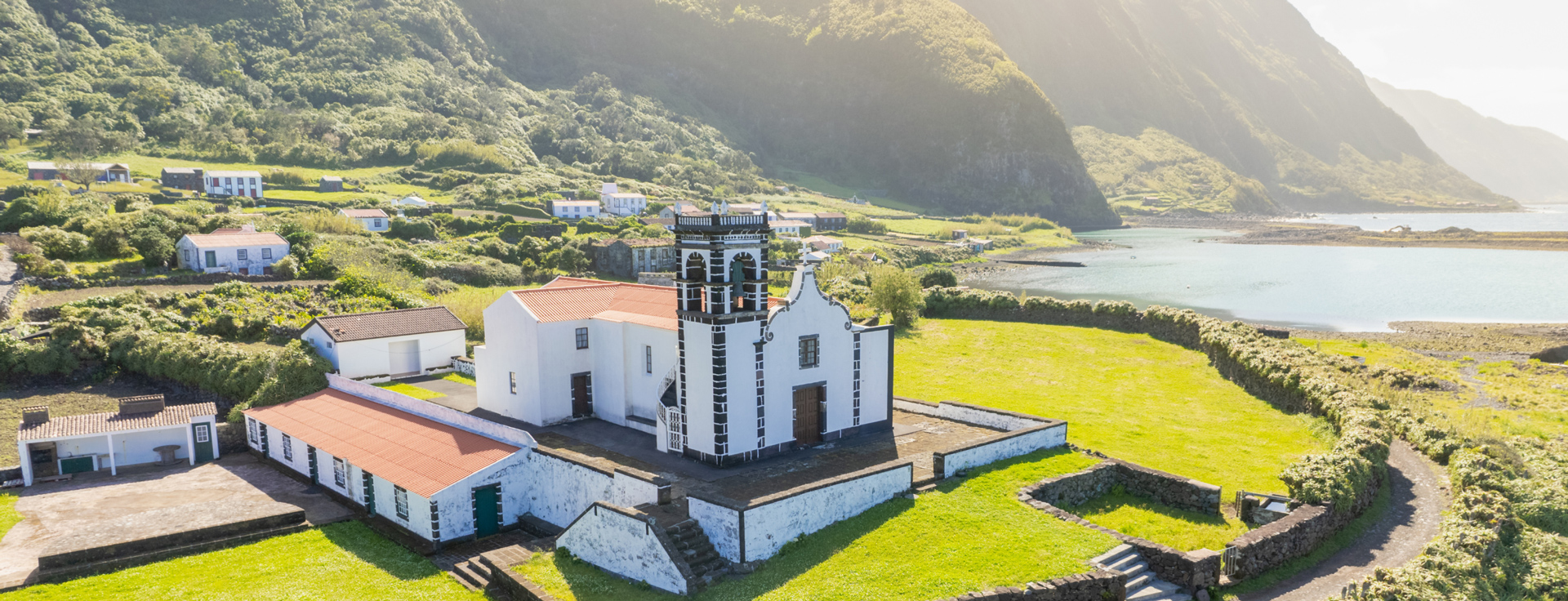
The people got together and decided to build a church. They thought they would build it on the other side of the lagoon, but when they tried to bring the stone there, they couldn’t. The place was there, near where St. Christ had appeared. The place was there, close to where St. Christ had appeared. After much sacrifice and work, the church was completed and the image was placed there.
Thus, that beautiful Fajã was renamed Caldeira do Santo Cristo.
And the people, who love to have fun in order to forget their toil and suffering, soon began to throw a very big and beautiful party, where religious celebrations were complemented by profane amusements. They danced joyfully, and it was frequent to hear the men singing this song during the dance:
“Oh Lord Holy Christ,
Where did he go to make his home?
To the rock of the Caldeira,
Near the salt water.”
At one point the priest, for whatever reason, didn’t want the Holy Christ in the church and decided to take it home. He took the image, but he couldn’t move, his feet were stuck to the floor. He then said to the sexton:
- Help me here, I can’t walk.
The sexton tried hard, but finally he confessed:
- Father, I can’t walk either!
- Then we can leave the holy man here - said the priest.
And so it was. Soon the feet and legs became agile and the priest and all the people were convinced that this was where Santo Cristo had to stay.